
Blog Post by Yari
March 12th, 2026
A blog post on sustainability in rare minerals and its impact on the global market.
If you want to understand the future, don’t look at the surface. Look at what powers the surface. Look into the sustainability of rare minerals… look into the past records that mineral has been mined from.
Beneath every iPhone, every EV battery, every data center, every AI model scaled to a trillion parameters, there is cobalt.
A metal most people never think about, and yet one that quietly holds the structure of the modern world together. As of 2025, the cobalt market is estimated to be roughly between $17 and $19 billion USD globally, with strong demand driven by batteries, portable electronics, EV’s, and superalloys used in aerospace.
Cobalt is quietly powering almost every single device around you. A reminder that every dream a founder dreams, no matter how digital and autonomous it appears, has a mineral reality. Most everyone you talk to will have the bias that AI is autonomous; this is a myth. It’s powered by technology, and technology requires physical sites, data centers, satellites, raw minerals, and materials.
Now take a step back. Turn this from concept into reality.
In this very moment, even during the acceleration of AI models, LLMs, transformers, backordered GPUs, and the ever growing demand from companies racing to train bigger and faster data center systems.
Cobalt sits quietly inside many of the batteries, alloys, and electronic systems that support this infrastructure. Sustainability, in corporate terms, basically means that you don’t overtake resources so that future generations still have access to the rare mineral.
At the end of every day, no matter how much AI advances into the AI revolution, it isn’t weightless. It doesn’t supply itself; it’s built on minerals, manufacturing, energy, and supply chains stretched across continents. It’s built, sadly, on children mining in the Democratic Republic of the Congo, on massive water cooling systems that impact the globe, environmental extraction, and geopolitical bargaining. It’s literally built on the Earth and human labor itself, and it requires massive input.
In simple words, we can only code so much before we have to confront what powers the code to perform the way it does.
Cobalt, a quick mineral macro lesson
In finance, cobalt is known as a commodity, in tech a dependency, and in AI, a constraint. But each industry fears one logical nightmare: constraints. Because constraints need workarounds, critical thinking, and the need for innovation. This often requires unparalleled honesty into what is essential for the supply chain to continue to be powered. All three of these fields; AI, finance, and tech, are increasingly shaped by dependencies on cobalt and other critical minerals.
Without it → many battery systems weaken and supply chains tighten.
Without batteries → mobility and electrification slow.
Without mobility → trade slows.
Without trade → GDP slows.
Without electrical power → AI infrastructure cannot scale.
This line of thought will help you in consulting. It’s why firms like McKinsey and Bain often look at systems thinking. It’s why they try to get you to critically think through chains of consequence during their recruiting games.
All GPU clusters, even fine tuned running models (supervised or unsupervised), have inference endpoints powered by physical components that most people outside of the field rarely acknowledge.
AI is not a cloud. It’s a mine, a factory, and a carefully curated supply chain held at the seams by geopolitics monitoring their minerals.
Cobalt shows us how progress has a cost.
But Why do this matter for founders, engineers and builders?
To put it simply, every innovation wave reaches a point where vision is no longer enough.
At that stage, dreaming and pitches are insufficient. What you need to do next is build. You cannot continue to lag; you must engineer it into existence. Cobalt is the phase of innovation where abstractions collide with physicality.
Everyone loves the ideation part; it’s the fun part. The pitch decks, mockups, prototypes, the “we’re revolutionizing X with Y” talk.
But building. Actually building. That’s when the universe asks you to prove that you mean it, and that’s what separates speculative bubbles from revolutions.
AI is now in the cobalt phase: the hype is fading; there’s a chat or LLM for everything. But as infrastructure demands rise, if you don’t have it, you’re not taken as seriously. Now more than ever, building is made easier with vibe coding. The world wants to see what you can build, and I don’t know about you, but I quite like being a bit like Tony Stark.
The financial truth behind mineral extractions
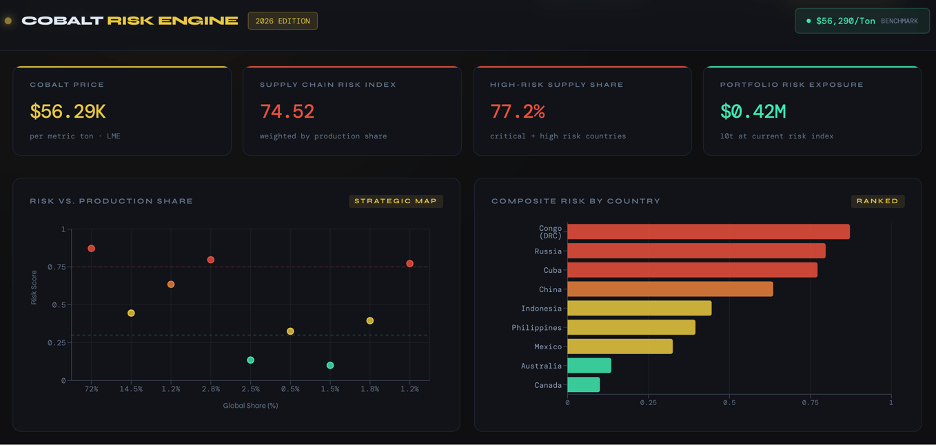
Cobalt has one of the most volatile supply demand curves in the world. Most minerals do, and it’s not because consumption is unpredictable, but because ethics, politics, and scarcity all exist precisely within the same square mile.
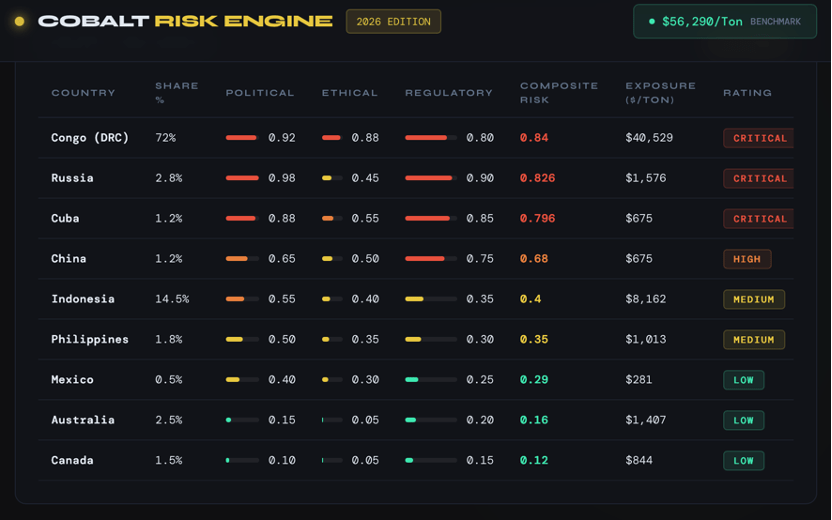
Roughly 70–76% of the world’s cobalt production comes from the Democratic Republic of the Congo (DRC).
Chinese firms like China Molybdenum, Huayou Cobalt, and Wanbao Mining hold ownership or financial stakes in many of the major industrial cobalt mines in the DRC, with Chinese-backed firms estimated to control a large share of the country’s cobalt output, often cited around 70–80%.
In the EV (electric vehicle) sector alone, China also dominates much of the lithium-ion battery supply chain and refining capacity. China currently accounts for roughly 70–80% of global refined cobalt production, which gives Chinese firms strong influence over battery supply chains.
In particular, Chinese firms source cobalt from major sites in the DRC, including; Tenke Fungurume, Sicomines, and Kinsenda, among others.
So the next time you ask yourself why BYD can sell cheaper cars, understand they can buy batteries in a market where much of the supply chain is vertically integrated and controlled.
To be precise, cobalt prices fluctuated significantly in recent years. Prices were roughly around $10 per pound at the end of 2024, rising toward $16 per pound in 2025 and reaching around $25 per pound in early 2026 as export controls and supply restrictions tightened.
Now reflect on this a bit.
At your local Whole Foods, at least in NYC, a pound of skirt steak is around $19. At certain moments during cobalt’s price cycle, a pound of cobalt traded for less than everyday grocery items.
The reality becomes grim the more you research. Artisanal mines in the DRC have long been associated with hazardous labor conditions, including child labor, unsafe mining environments, and extremely low wages, $2 USD within a 2 day period.
The ethics of AI are flawed in what powers it, and yet the entire AI economy depends on it.
This is only one sector, not including any other environmental factors that cause harm in the process of mining and producing cobalt.
Being able to finance cobalt shows us where the concentration risk disaster is bottlenecking, where it is waiting to happen.
Big tech often forgets this, and it often goes ignored until the price spikes.
From this article, I want you to understand the following:
You cannot build the future without understanding the cost of the present.
By democratizing AI, you must acknowledge the minerals required, how to sustain it without supply chain constraints, and the impact on human life.
Innovation requires extraction; that’s the responsibility behind building. AI models need cobalt, but we need to build the tools used for it better. As AI accelerates, cobalt consumption will rise unless we innovate better, more efficient chips, computers, clouds, and data centers. This means finding workarounds: recycling cobalt for reuse, new battery chemistry that lasts longer without overheating, supply chain transparency in how these minerals are being mined, and synthetic materials.
It shouldn’t be a luxury to be ethical. It should be an imperative need to re-innovate how to extract and reuse these minerals.
We are entering an era where building the future requires repairing the present supply chain. This is where you, as the reader, come in. As analysts, strategists, builders, and leaders, our responsibility is not simply to optimize. It’s to shape. To choose frameworks that account for the full cycle, economic, ethical, and environmental.
AI is powerful. Finance is powerful. But neither absolves us from accountability.
Cobalt reminds us that progress is extracted from somewhere, and even someone.
There comes a moment where you stop asking, “What should I build?”
And you start asking, “What is worth building?”
That is the cobalt moment, the need to build.
The moment where vision and responsibility meet. AI isn’t good or bad. It’s a tool, and like cobalt, its impact depends on the hands that shape it. It’s not about being passive beneficiaries of innovation, but intentional architects of it. To build things that matter, to question the cost, improve the chain, and leave systems more ethical than we found them, because the future will not only be written by whoever builds the fastest. It will be written by whoever builds the most responsibly as well.
Here’s the Links:
 The Yariverse