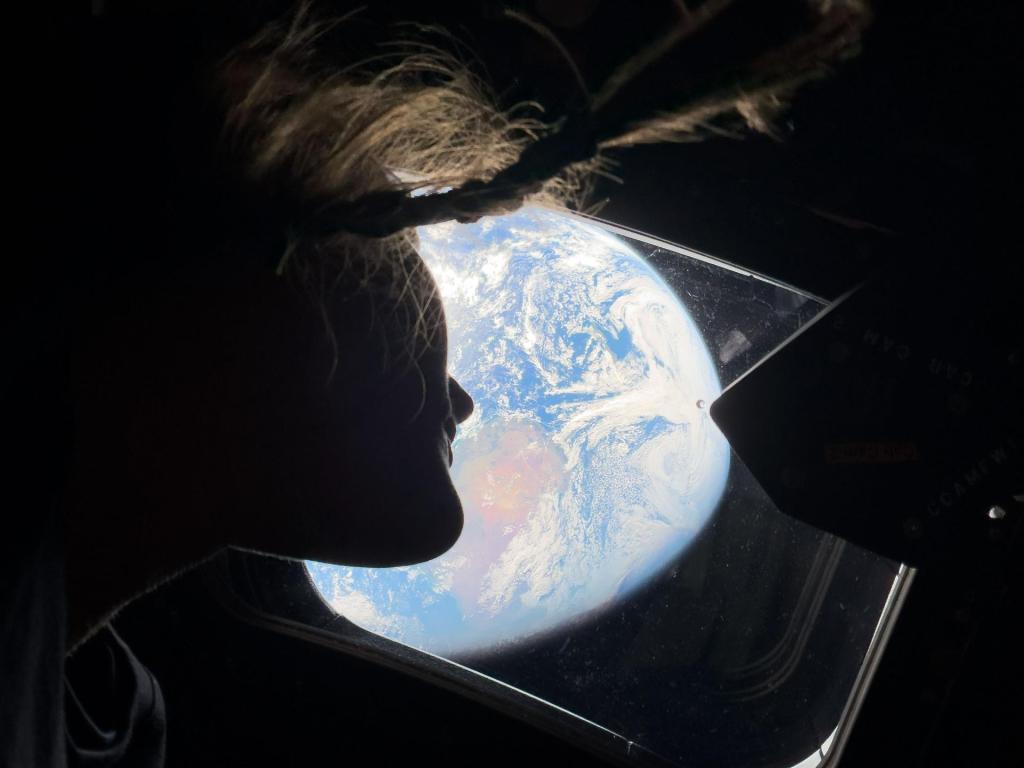
There’s something poetic about graduating from my Master of Science in the same year as a woman finally circles the Moon on Artemis II, having an engineer boyfriend that worked for NASA, and an aunt that loves flying planes.
Somewhere above all of this, literally 252,756 miles away at its peak, a woman orbited the Moon for the first time in U.S. history. Her name: Christina Koch.
By now you’ve probably seen all her TikTok videos of her dancing, super cute moves, even more sublime resume. Something you might now know, is that Christina Koch and Jessica Meir conducted the first all-female spacewalk on October 18, 2019, outside the International Space Station. Koch even set the record for the longest single spaceflight by a woman, a total of 328 consecutive days before being selected for her Artemis II mission. Overachiever queens.
Her flight sits exactly 57 years after Apollo 11 Moon Landing, when Neil Armstrong took that “That’s one small step for man, one giant leap for mankind” that somehow wasn’t meant for everyone at the time it was said. Because here’s the part we don’t romanticize enough: In 1969, America could put a man on the Moon but not a woman.
Women weren’t allowed to be astronauts in the U.S. space program in 1969, that means Koch’s historic mission despite how qualified she is wouldn’t have been possible then in 1969. At the time of the first U.S mission to the moon, NASA required all astronauts to be military test pilots, a role that was then only restricted to men. While women served in critical engineering and technical roles like Frances “Poppy” Northcutt in Mission Control, women weren’t admitted into the astronaut corps until 1978.
And this got me thinking what has changed since the first a US mission to space to Artemis II? How much can a girl dream of being?
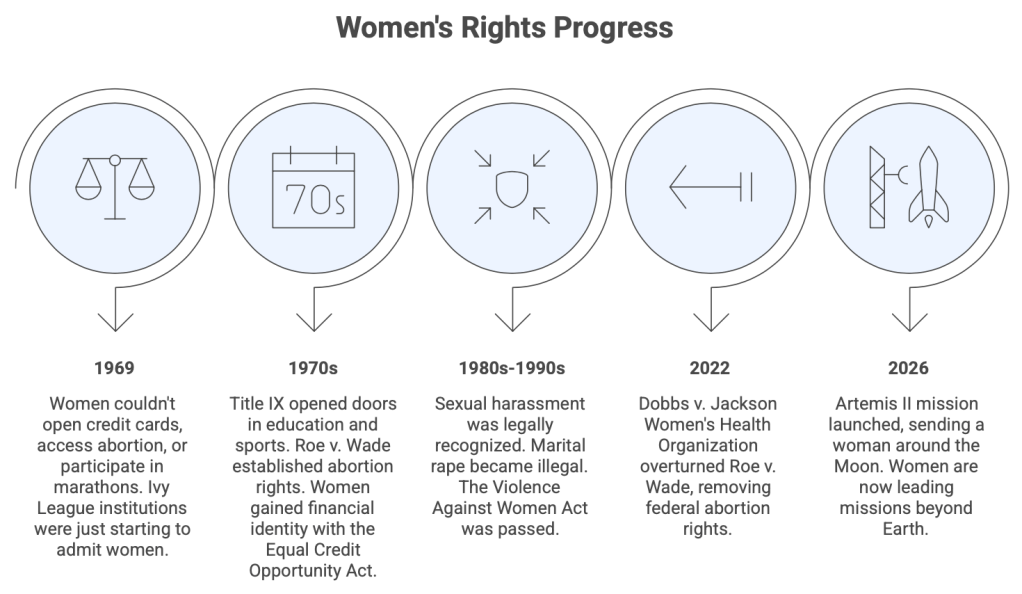
Well in 1969, the same year humanity achieved what was arguably the greatest technological milestone in modern history women in the United States were still negotiating basic autonomy.
Women:
- couldn’t open a credit card in their own name.
- couldn’t legally access abortion nationwide.
- couldn’t officially partake in marathon races.
- Many Ivy League institutions including Yale(1968) and Princeton(1969) had only just started admitting women. Columbia didn’t start until 1983.
- Marital rape wasn’t recognized as a crime
- Jury service wasn’t guaranteed for women across all states
Whenever you watch those archived 1969 mission’s grainy black and white clips of astronauts bouncing across lunar dust, you’re not just watching innovation but selective progress. Let’s take a history journey in what’s changed.
In the 1970s: Financial and Bodily Autonomy Begin
- 1972: Title IX opened doors in education and sports to woman, allowing them entrance.
- 1973: Roe v. Wade established federal abortion rights to woman’s healthcare.
- 1974: Equal Credit Opportunity Act, women could finally have credit cards in their own name. Five years after the Moon landing, women gained financial identity.
- 1977: the right to serve in US military combat roles.
- 1978: allowed to join astronaut corps.
The 1980s-1990s: Legal Recognition of Harm
- 1977: Sexual harassment was recognized legally in US courts.
- 1993: Marital rape became illegal in all 50 states.
- 1994: Violence Against Women Act
It took until the 1990s, for the law to formally acknowledge that harm inside a marriage is still harm and it wasn’t until 2015 that same-sex marriage rights were legally recognized. Women now hold approximately 29% of congressional seats, compared to fewer than 2% in 1969.
But not all change was progress, in 2022:
- Dobbs v. Jackson Women’s Health Organization overturns Roe v. Wade
And just like that, a right that stood for nearly 50 years disappeared. Which tells us something important: Progress is not a straight line. It’s like a portfolio, volatile, reactive, and constantly needs to be rebalanced.
But here’s the exciting part, in 2026: A Woman Orbited the Moon on Artemis II
On April 2026, Artemis II Mission launched and for the first time, a woman traveled beyond low Earth orbit and circled the Moon. Not as a passenger or symbolic inclusion but as a core part of the mission, as a 100% qualified astronaut.
Here’s the truth; in 1969 women weren’t fully included in the systems shaping the future but in 2026 women are helping lead missions beyond Earth (Thank you Koch!). That’s not just progress; it’s reallocation of opportunity for all women.
What Christina Koch Represents (Beyond being one super qualified astronaut)
Christina Koch isn’t just an astronaut in this story. She’s a signal that:
- Access has expanded
- Representation has shifted
- The definition of “who gets to explore” has changed.
But she’s also a reminder: Being the first doesn’t mean the work is done. It means the work has only just started.
Graduating in This Moment Means Something Different
Graduating from Columbia in 2026 doesn’t just feel like an academic milestone. We’re not just inheriting systems; we’re inheriting unfinished work and there’s something powerful about realizing that:
- The generation that couldn’t open a credit card raised the generation that’s now building complex AI and quant finance models
- The institutions that once excluded women are now graduating them at scale in ivies (just like me!).
- The same country that restricted autonomy is now sending women around the Moon and hopefully one day beyond that into space exploration missions.
So, here’s to the next generation of record setters making it the norm:
Congratulations on graduating class of 2026!

