
Blog by: Yari
Date: June 29th, 2026
There is a very specific kind of betrayal that happens at 8:17 a.m. on a Monday morning.
There you are standing in front of a closet that’s by all measurable standards, full. Hangers packed so tightly they’ve formed a political coalition, in the middle of all that a top you bought because it made you feel like quiet luxury, a blazer that whispered Columbia networking event, pants that once promised effortless (literally the pant name), and at least three pieces that were clearly purchased by a version of you who believed she’d become a coastal Italian vacay influencer by June, and big surprise, June is almost over.
Yet, somehow, you have nothing to wear. Not nothing in the literal sense. You have options, enough clothing to costume a small indie film about a someone rediscovering herself through oat milk, LinkedIn, and mild seasonal depression. But you can’t make an outfit, yet your closet is full and you can’t bring yourself to get an Aritzia stylist. The fashion paradox: suffering isn’t from scarcity but friction.
Consumers like us buy pieces because they’re cute, aspirational, discounted, recommended, viral, or emotionally necessary after a Tuesday work session. But when it comes time to assemble those pieces into an actual look, the closet turns into a museum archive with no curator. The cream blazer you bought last week is lost behind the black trousers from two years ago, and your confidence is somewhere under the laundry chair hiding behind piles of clothes.
The question isn’t: “Do I need more clothes?” it’s “Why can’t I see what I already own?”
Well, your girl (me) has an app/python code project that you make yourself and use, that’s where Your Closet comes in.
The App Idea: A Closet That Remembers What You Forgot You Bought
Your Closet is an app designed for the girl who owns clothing but cannot access the outfit hidden inside it. The concept is simple: upload photos of your clothing pieces, tag each item by category, and let the app help you rediscover combinations you already own. Instead of pushing you to shop more, it turns your existing wardrobe into a searchable, style aware closet.

Think Cher Horowitz’s closet from Clueless, but less Beverly Hills and more “I have class in fifteen minutes, a presentation at three, and no emotional capacity for denim because I haven’t worn denim in 4 years.”
The app begins with the basics:
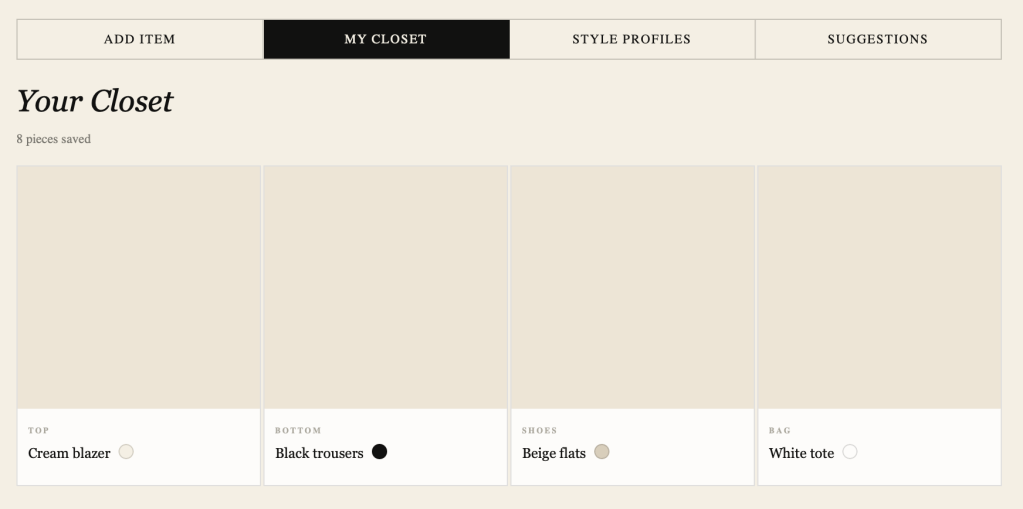
You add an item: a cream blazer, black trousers, beige flats, white tote, thrifted skirt, going out top, oversized sweater, favorite boots. Each piece gets saved into your digital closet with a name, category, notes, and color.
You choose a style profile, maybe you want:
- Quiet Luxury: beige, white, black, clean lines, minimal contrast.
- Old Money: cream, navy, camel, tailored energy, “my grandfather owns a boat, but I still use student discounts, and no one is above a discount (neither was papa)”
- Soft Girl: pink, lavender, cream, gentle silhouettes.
- Monochrome Editorial: black, white, sharp contrast, “I read theory and I will not explain my shoes.”
From there, the app suggests outfits from your own closet, you don’t need a new outfit girlie. No shopping cart, influencer affiliate link, or complete the look that somehow costs $436, just your clothes, reorganized into different possibilities.
The Real Problem: We Own Pieces, Not Outfits
Most of us shop item by item. A shirt without the system, pants without the pairing. Statement pieces before we realize what the statement is: “I don’t know what to wear with this.”
That’s why a closet can be full and still feel useless. Clothing can feel fragmented data. A top is just a top until it is matched with the right bottom, shoes, outerwear, bag, and mood. Without that matching layer, the closet becomes a database with no search function. It’s not that you lack style. It’s that your wardrobe lacks product management. Your Closet reframes getting dressed as a pipeline, inventory management before breakfast.
The ETA Pipeline Simplified: Extract, Transform, Act
The app can be explained through an ETA pipeline: Extract, Transform, Act.
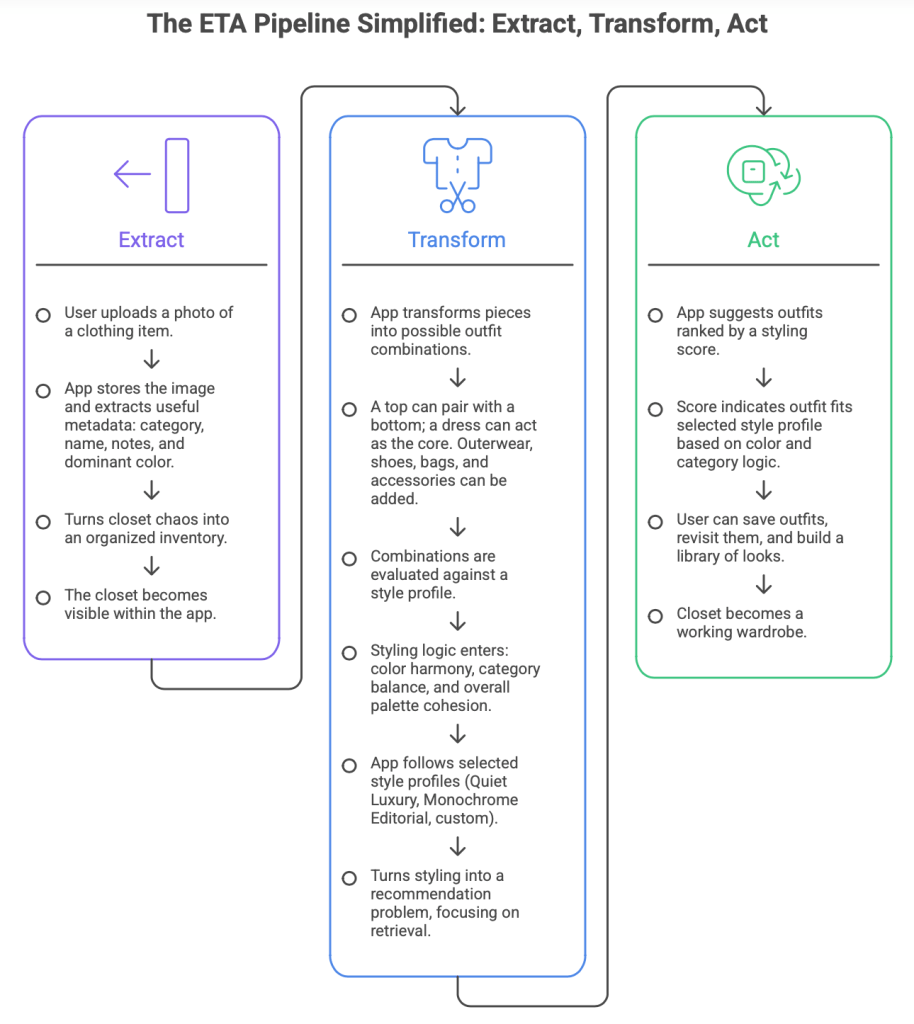
Step one Extract: Pull Meaning from the Closet
The user (you) uploads a photo of a clothing item. The app stores the image and extracts useful metadata: category, name, notes, and dominant color. A black wool blazer becomes more than a forgotten hanger. It becomes structured data: outerwear, black, tailored, useful for work, dinner. This matters because the app is not trying to understand fashion through vibes alone. It’s turning closet chaos into an organized inventory. The closet becomes visible within the app.
Step two Transform: Turn Clothes into Style Logic
Next, the app transforms those pieces into possible outfit combinations.
A top can pair with a bottom; a dress can act as the core. Outerwear, shoes, bags, and accessories can be added. Then those combinations are evaluated against a style profile. This is where the styling logic enters.
The app looks at color harmony, category balance, and overall palette cohesion. If you choose Quiet Luxury, it rewards outfits that stay close to beige, white, black, taupe, and soft neutrals. If you choose Monochrome Editorial, it looks for sharp black and white combos. If you create your own profile, the app follows your selected palette and mood. It turns styling into a recommendation problem, not because fashion should become robotic, but because the most annoying part of getting dressed is often not creativity, it’s retrieval. The app retrieves the combinations your closet already contains and makes outfits you would’ve never considered.
Step Three Act: Suggest, Save, Share, Repeat
Finally, the app acts. It suggests outfits ranked by a styling score. The score doesn’t mean this is objectively fashionable, because fashion isn’t a standardized test and Anna Wintour isn’t hiding in your database. Instead, the score means: this outfit fits the selected style profile based on color and category logic. The user can save outfits, revisit them, and build a library of looks. That’s the magic of it, your closet stops being a pile of individual purchases and becomes a working wardrobe.
But wait, you’re in college, well the app has a version for that too: Borrow the Fit, Not the Life.
Now imagine this app on a college campus. You and your friends are getting ready for class, internship interviews, club events, birthdays, networking nights, coffee dates, and the occasional “I need to look casual but devastating fit.
Everyone has clothes. Everyone has panic. Nobody wants to admit they’ve tried on seven outfits and are now emotionally attached to a hoodie because there were too many options.
The college version of Your Closet adds a social layer.
Students can create accounts with their closest friends, keep their own closets private, and choose which saved outfits make public in real life. Borrowing doesn’t mean copying someone’s closet or taking their photos as your own. It means saving the combination as styling inspiration, creating your own sisterhood of the traveling pants iconic moment. Maybe your friend pairs a cream blazer with black trousers and beige flats. You don’t need her exact blazer just the super cute, shared language.
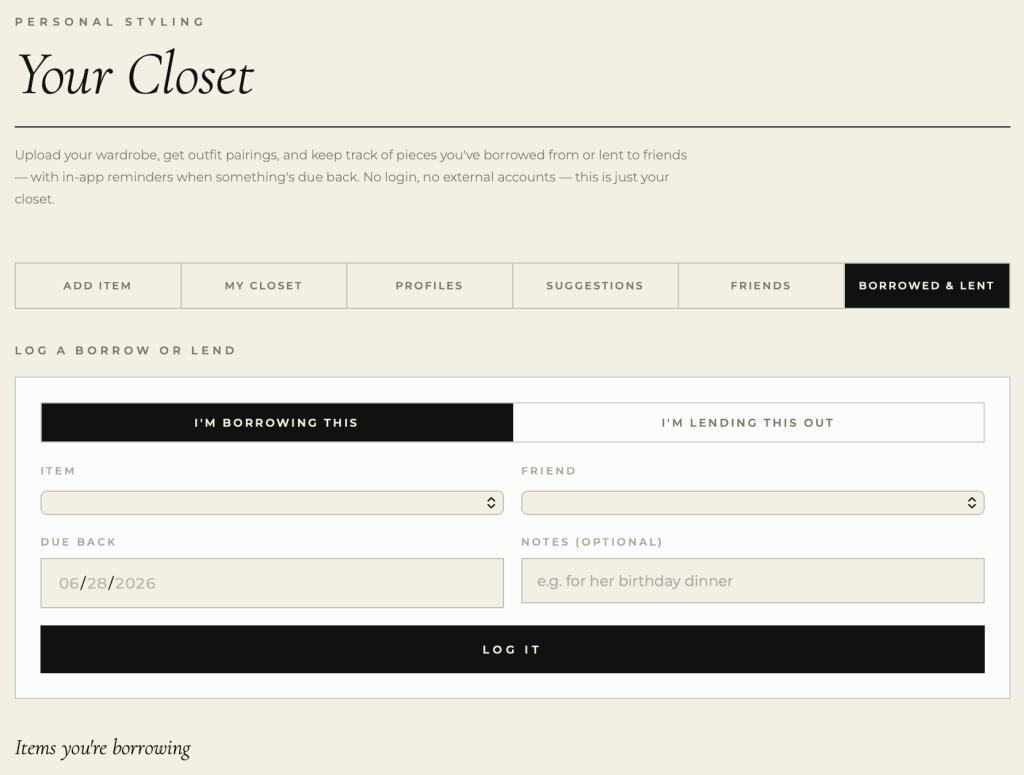
Instead of asking, What are you wearing tonight? and receiving the deeply unhelpful answer of I don’t know you can browse actual outfit ideas from people whose style you trust.
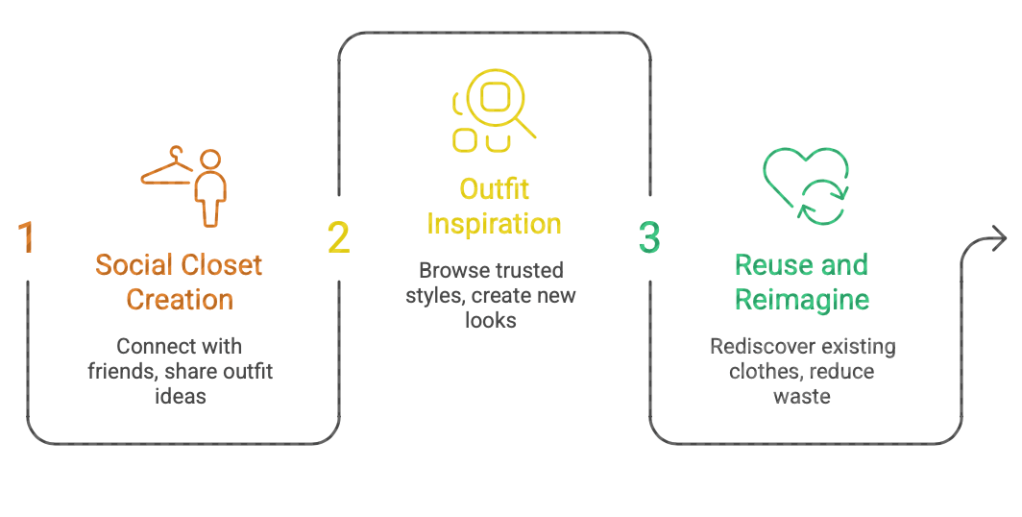
For college students, this solves three problems at once:
- Decision Fatigue Reduction: getting dressed before class shouldn’t require the cognitive load of a final exam.
- Sustainability Through Encouraging Reuse: When students rediscover their existing clothing, they’re less likely to panic buy something new for every event. Keep their budget intact.
- Social Styling Without Making it Performative: The goal isn’t to create another platform where everyone competes to look perfectly curated. The goal is to make closets more useful, more collaborative, and less overwhelming.
The Styling Logic: Vibes, But Make Them Stress Free.
A good outfit isn’t just matching colors. It’s proportion, occasion, silhouette, contrast, texture, and confidence. That means the app shouldn’t stop at “this shirt is beige and this bag is beige, congratulations.” Beige alone isn’t a personality, no matter what TikTok says.
The styling layer should eventually account for:
- Occasion: class, work, dinner, party, travel, presentation, casual errands.
- Weather: the best outfits can still be wrong if you’re freezing outside Butler Library.
- Comfort: whether an item is itchy, tight, too formal, too casual, or only wearable when your confidence has direct deposit.
- Frequency: what you’ve worn recently, the app can help you avoid repeating the same three pieces.
- Style goals: polished, romantic, sporty, academic, editorial, minimalist, soft, bold, vintage, downtown, corporate, or “I am trying, but not in a visible way.”
- Social context: whether an outfit is for a presentation, friend hangout, date, interview, or I might run into someone and need plausible deniability. The best version of this app doesn’t just say what matches, it explains why. Like: Pair the cream blazer with black trousers and beige flats. The neutral palette fits Quiet Luxury, while the structured blazer balances the softer shoe, add the white tote to keep the look clean and campus friendly. That explanation teaches the user how to style, not just what to wear.
Why This Is Bigger Than Fashion
At first, this sounds like just another a closet app. Cute. Useful. Somewhat niche. But underneath is a bigger cultural problem: we’re drowning in personal inventory. Clothes, screenshots, bookmarks, notes, saved TikToks, open tabs, half finished ideas. We collect more than we can retrieve. Your Closet is really about retrieval.
It asks: what if the things we already own could become easier to use?
A question that merges at sustainability, finance, design, and mental destress. Nobody should be defeated by a drawer before 9 a.m. The app doesn’t need to shame people for shopping. It just needs to make shopping less automatic by making ownership more visible. Sometimes the outfit is already there, it’s just buried under bad lighting and the emotional damage of trying on jeans.
The Privacy Concern: The Closet Remains Personal
A closet is intimate. It reveals size, taste, budget, identity, aspiration, insecurity, and lifestyle. So, a closet app has to take privacy seriously. The local version of Your Closet is powerful because it doesn’t need external fashion APIs to function. It can store clothing photos, extract colors, and generate suggestions all locally. That’s a strong starting point for user trust. The friend sharing version needs even more care. Users should control what’s private, what’s public, and what can be borrowed as inspiration. A college closet app should feel like sharing with friends, not like being surveilled by a tiny fashion landlord. The best product principle is simple: the user owns the closet, the outfit, and the visibility.
Your Closet is for anyone who’s ever looked at a full wardrobe and felt personally attacked. It’s for the college student running late to class. The intern trying to dress like she belongs in the room. The friend group preparing for a birthday dinner. The person with great pieces and no system. The girl who keeps buying black tops because black tops feel safe, only to realize she now owns a small choir of identical fabric.
It’s not about having more, it’s about seeing better. The future of fashion tech doesn’t have to be another app telling us what to buy. It can be an app helping us remember what we already chose, already loved, and already paid for, because your closet isn’t empty.

