
Blog Post By: Yari
Date: 09/26/2026
This case focuses on Stripe’s acquisition of Bridge (closed February 2025) and its expansion into stablecoin and agentic payment infrastructure, including its preview of stablecoin funded machine payments via the PaymentIntents API in early 2026, and the July 21, 2026 announcement that Ramp is using Bridge and Privy to power stablecoin payments and accounts.
Current Overview:
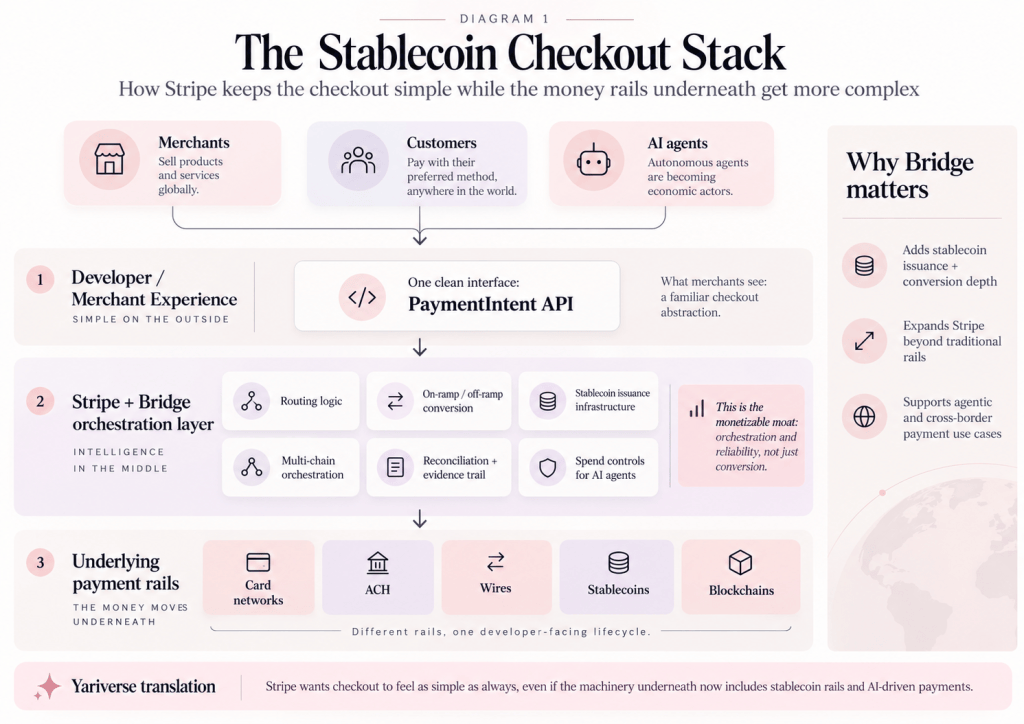
Stripe, a payments infrastructure company, whose core product is a clean, stable developer abstraction (PaymentIntent) sitting on top of an increasingly complex set of money rails: card networks, ACH, wires, stablecoins and blockchains. Bridge specialized in exactly the part of that stack Stripe didn’t have: a stablecoin issuance, on ramp and off ramp conversion, and multi chain orchestration. The acquisition was best read not as a crypto bet but as a vertical integration move, similar to how a logistics company might acquire a warehouse network rather than merely a shipping API.
The timing matters more than you realize since as of 2026, AI agents are beginning to act as economic agents in their own right.
Ex #1: an AI research marketplace that pays data contributors autonomously per API call. That shift changes who the “customer” making a payment decision is, and therefore what authorization and control need to look like.
Think of Stripe like the checkout counter at your favorite store. You don’t care which bank, network, or payment rail moves the money behind the scenes. You just want your payment to work, your funds are available and you need that bag. Bridge gives Stripe more control over what happens behind that counter.
The Key Strategic Issue
The question is should Stripe expose stablecoin settlement through the same abstraction merchants already trust, and how much of the real economic and compliance difference between a card payment, a bank wire, and a stablecoin transfer should be visible to the merchant making the routing decision, versus hidden for simplicity. The question then genuinely strikes tension, not a solved problem. But for hiding complexity is Stripe’s entire value proposition. But the article’s own “failure modes that look fine in a meeting” warn against routing purely on quoted fee, ignoring failed settlement cost, or treating every jurisdiction the same, all of which are easy mistakes to make precisely because the abstraction is so clean.
Basically. the how much should the customer have to think about? Apple doesn’t make you understand battery chemistry to use an iPhone, but with high investment, hiding too much can also hide real costs and risks. You as a Fintech Girlie never want to hide or ignore any costs or risks, they come with extreme downsides and loses.
The Key Strategic Issue
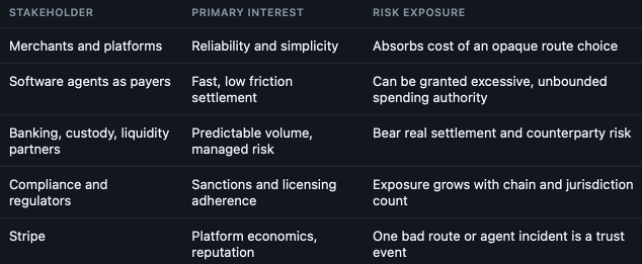
Every simple checkout has a surprisingly large group chat behind it. Merchants want lower costs, customers want convenience, banks and regulators want control, and Stripe has to somehow keep everyone happy without making checkout feel like filing your taxes, which is why the stakeholder map is an important resource to establish early.
Frameworks Applied
Unlike other companies Stipe chose a Platform strategy:
- Build
- Buy
- Or Abstract.
Stripe chose to buy deep infrastructure rather than build a thin integration or simply partner. This is consistent with the view that the durable competitive advantage in payments infrastructure is operational depth, meaning partner coverage, licensing, liquidity relationships, and reconciliation accuracy, none of which a competitor can copy by reading Stripe’s API documentation.
An API shape is copyable in weeks.
A compliant, reconciled, multi jurisdiction settlement network isn’t.
Basically: Stripe didn’t just rent someone else’s tech. It bought more of the machinery underneath its own product. Think Zara owning more of its supply chain instead of depending entirely on outside vendors, costs should in theory be smaller.
Porter’s Five Forces (condensed).
Porter’s Five Forces encompasses: Who has leverage here?
Stripe may be powerful, but merchants can shop around in a capitalist market, banks and blockchains still control important infrastructure, and competitors are all trying to build their own version of the same checkout lane.
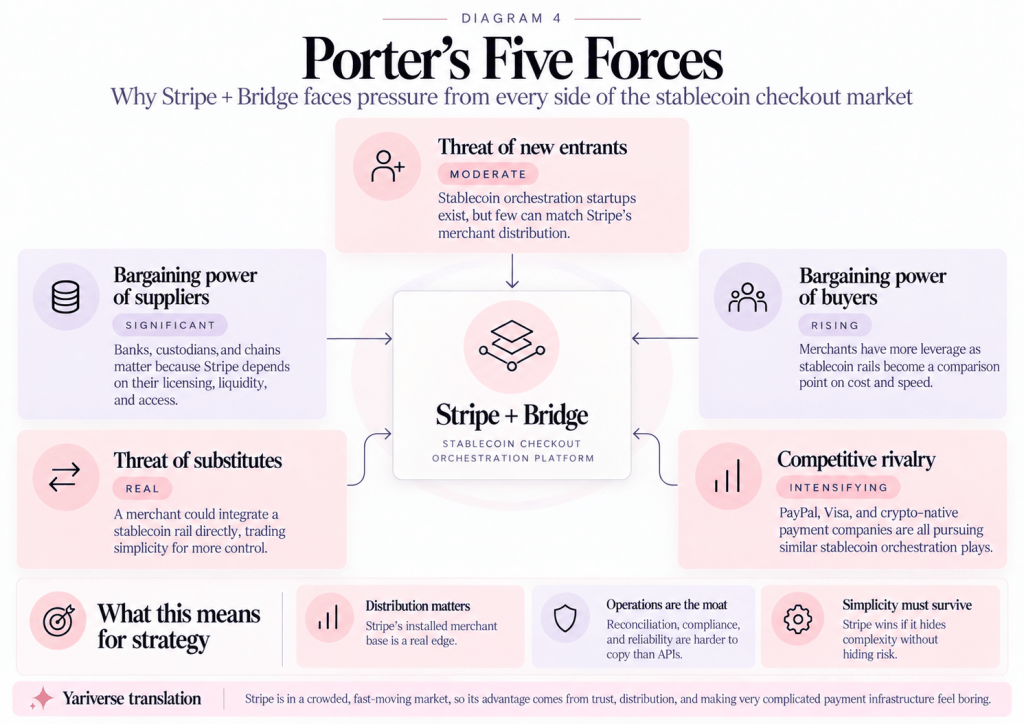
- Competitive rivalry: intensifying, as PayPal, Visa, and crypto native payment companies all pursue similar stablecoin orchestration plays.
- Threat of new entrants: moderate. Stablecoin orchestration startups exist, but few can match Stripe’s existing merchant distribution.
- Bargaining power of buyers / Buyer Power: (merchants): rising, as stablecoin rails become a comparison point on cost and speed.
- Bargaining power of suppliers / Supplier Power: (banks, custodians, chains): Significant. Stripe depends on their licensing and liquidity.
- Threat of substitutes: real. A merchant could integrate a stablecoin rail directly rather than through Stripe, trading simplicity for control.
RECEIPTS framework:
Reported fact, Economic mechanism, Controls, Evidence, Implementation, People, Tradeoffs, Source boundary.
A checklist for platform capital or partnership decision, and it is the frame this case study follows structurally: separate what is publicly confirmed from what is strategic inference.
RECEIPTS is the show me your work section. What do we actually know, what are we estimating, what could go wrong, who is affected, and where does the evidence stop? Very finance girlie due diligence.
Case Study Source:
The acquisition date (February 4, 2025), specifically the Sessions material described Bridge orchestration, and the Ramp announcement are sourced facts. The architecture description, the route economics, and the recommendation below are Yariverse and case author analysis, not confirmed internal Stripe design or disclosed financial results, this is purely for educational purposes.
In simple terms: Stripe told us some things publicly, the rest is analysis, we don’t have Stripe’s top secret internal strategy deck. So, please don’t use it like that.
Profit Opportunity & Cost Side:
There are 2 separate, legitimate monetization stories layered on top of this deal, and a good case answer keeps them distinct rather instead of a vague stablecoins are good for business claim.
Stablecoins aren’t automatically profitable just because they’re newer tech. The real question is where Stripe can create enough convenience, reliability, or control that customers are willing to pay for it.
Cost side, for a merchant or platform choosing a route:
Cross border settlement carries three real costs that a single quoted fee usually hides:
- The fee itself, the value of time lost to settlement delay.
- The expected cost of a failed transfer needing rework
- Dispute resolution.
A simple way to make this concrete: take a monthly cross border payment volume, say five million dollars, and compare a traditional bank wire route (lower fee, slower settlement, low failure rate) against a stablecoin route (lower fee, near instant settlement, a different and still maturing failure profile). At that volume, even a fraction of a percentage point of failure related rework cost is tens of thousands of dollars a year, which is exactly why route selection deserves a real decision process rather than a default.
Simple terms: The cheapest looking payment option isn’t always actually the cheapest. A $5 delivery fee is not a bargain if the package arrives late, gets lost, and requires three customer service calls. Payments work the same way.
Platform side, for Stripe:
The monetizable asset isn’t the stablecoin conversion itself, which is a thin margin commodity function. It’s the orchestration and reconciliation layer: the promise that a merchant’s payment state, retries, and evidence trail behave identically whether the money moved over a card network or a blockchain. That reliability is what a platform can charge a small premium for and it’s defensible for as long as Stripe’s operational depth outpaces a challenger’s ability to copy it.
Stripe’s valuable product isn’t simply: we can move a stablecoin. Lots of companies can move money. The harder part is making every payment behave predictably when something fails, gets refunded, needs reconciliation, or has to be explained later.
The new revenue surface; agent commerce:
If AI agents become routine buyers, transaction volume from machine initiated payments is a genuinely new top line opportunity, not a reshuffling of existing merchant volume. Capturing it responsibly requires the guardrail products described below to exist first, since a platform can’t monetize agent payments it isn’t willing to authorize safely.
In words, today you usually click buy. Tomorrow, your AI agent might do it for you. That creates more transactions but it also creates the slightly terrifying question of exactly what your AI is allowed to buy with your money.
Strategic Options Considered:
This is the decision table. Stripe can optimize for simplicity, push everyone toward stablecoins, or build a smarter system that considers price, speed, reliability, and risk together.
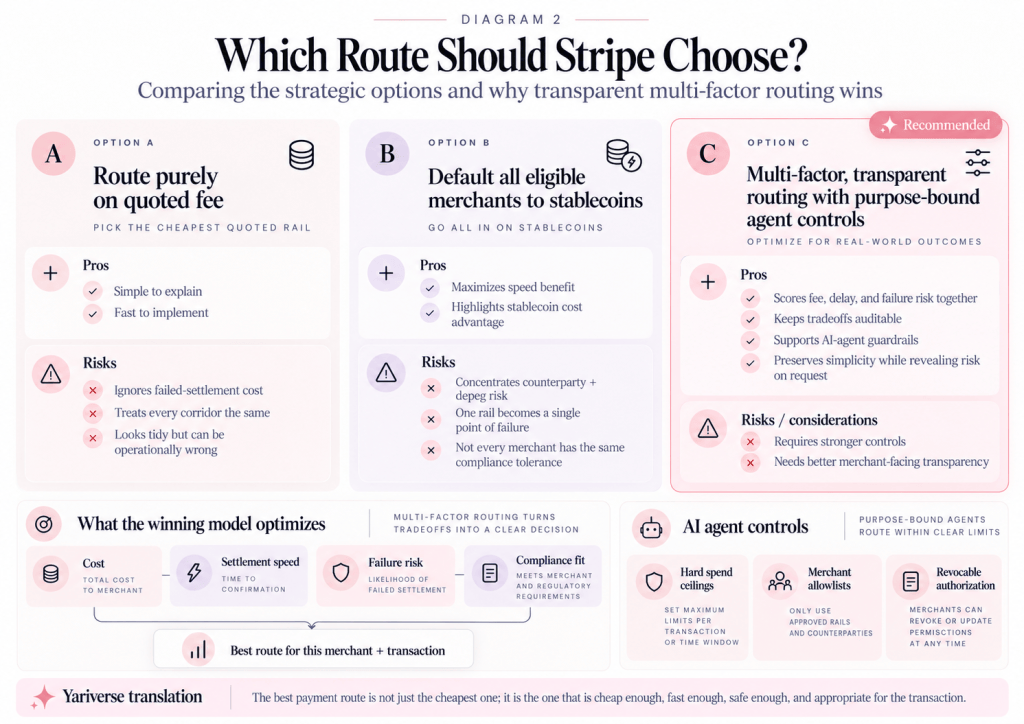
Option A: Route purely on quoted fee
Simplest to implement & explain. Rejected as a primary strategy, as the source article explicitly flagged it as a failure mode that looks fine in a meeting: it ignores failed settlement cost and treats every jurisdiction as equivalent, both of which can produce a confident, numerically tidy, and operationally wrong answer.
This is the Expedia sort-by-cheapest problem. The lowest number looks great until you realize the flight has three layovers, no luggage, and lands six hours later.
Option B: Default all eligible merchants onto the stablecoin rail.
Maximizes the speed and cost benefit Stripe is trying to sell, but concentrates counterparty, depeg, and compliance risk onto a single rail for every merchant regardless of that merchant’s actual risk tolerance or regulatory exposure. This is a single point of failure dressed up as a simplification.
Faster and cheaper sounds amazing, but putting everyone onto one payment rail is basically putting the entire outfit budget on one credit card. Convenient until the card stops working.
Option C: Multi factor, transparent routing with purpose bound agent controls.
Score routes on fee, settlement delay, and failure risk together, refuse to call a route optimal if a cheaper, faster, and safer alternative exists, and pair the routing logic with hard spend ceilings, merchant allowlists, and revocable authorization for any agent initiated payment. This preserves Stripe’s abstraction advantage while keeping the real tradeoffs auditable rather than hidden.
Instead of asking only what is cheapest? ask what is cheapest, fast enough, reliable enough, and appropriate for this particular transaction? Much more boring. Much more useful.
Recommended Option: Adoption of Option C.
The core argument is that Stripe’s moat isn’t the stablecoin conversion, it’s trustworthy operations, and trustworthy operations require that the tradeoffs a route encodes remain visible to the party bearing the risk, even while the developer facing interface stays simple. A merchant should be able to see on request, why a given route was chosen and what it would’ve cost to choose differently. An agent should never be able to spend outside an explicitly granted, revocable mandate. Both of these are product decisions, not afterthoughts.
Keep Stripe easy on the surface but let businesses see the receipt behind the decision. Simplicity for the user should not mean opacity for the person taking the financial risk.
Implementation of Roadmap
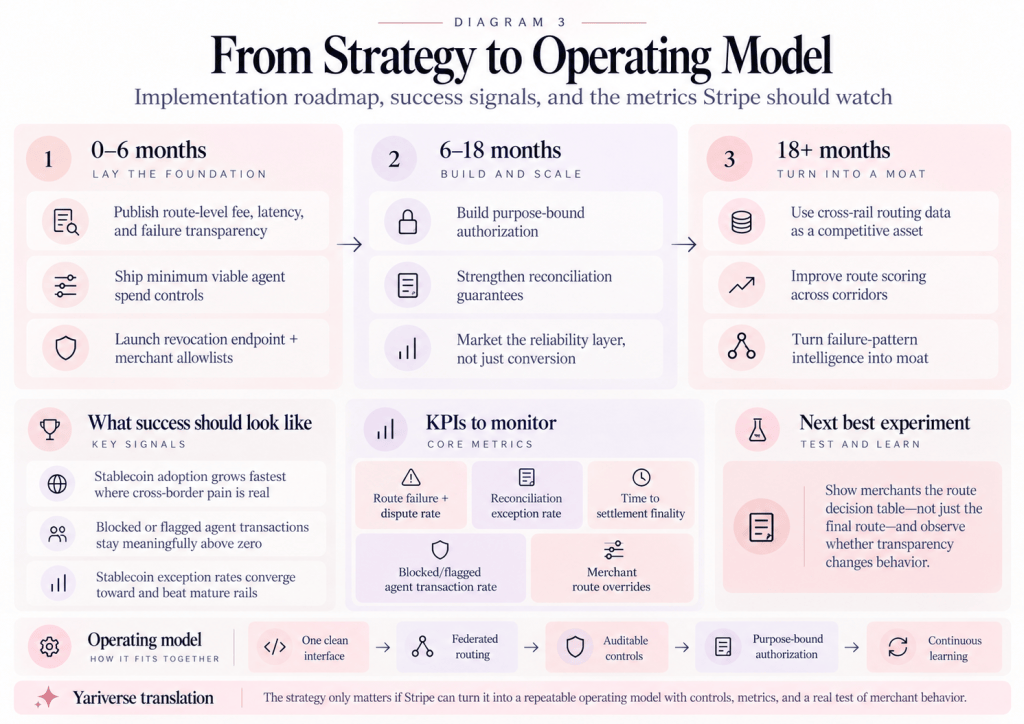
–> Near term, 0-6 months.
Publish route level fee, latency, and failure transparency to merchants instead of a single blended rate. Ship a minimum viable spend control product for agent initiated payments: hard ceilings, merchant allowlists, and a revocation endpoint.
Start with the controls you would want before letting an AI near your Amex: spending limits, approved merchants, an off switch, and visibility into why a payment took a particular route.
–> Medium term, 6-18 months.
Build purpose binding into the authorization flow itself, so an agent’s credential specifies what it is allowed to buy and from whom, not just how much it can spend. Extend reconciliation guarantees to be visibly stronger than what a single bank offers on its own, and market that strength directly.
The next step is making authorization more specific. Instead of telling an AI you can spend $500, tell it you can spend up to $500 on this type of purchase, from these merchants, for this purpose.
–> Long term, 18+:
Use the accumulated routing and failure data as a genuine competitive asset: better route scoring than any single bank or chain could produce alone, because Stripe is the only party seeing failure patterns across all of them at once.
Eventually the data becomes part of the moat. Stripe could learn which payment routes actually work best across thousands of situations in a way that any single bank or blockchain can’t easily replicate.
Moving Forward & Improvements
If this strategy works, three signals should appear in order.
- First, merchant adoption of the stablecoin route should grow fastest among businesses with genuine cross border pain, for example marketplaces paying overseas contributors on weekends, rather than being adopted uniformly, since uniform adoption would suggest merchants are chasing a headline rather than solving a real settlement problem.
- Second, the ratio of blocked or flagged agent transactions to total agent transaction volume should stay meaningfully above zero and should not trend toward zero over time. A near zero block rate is a warning sign that controls have become decorative rather than a sign that agents have become perfectly behaved.
- Third, reconciliation exception rates on the stablecoin rail should converge toward, and eventually beat, the exception rates on Stripe’s most mature existing rails, which is the real test of whether boring infrastructure has actually been achieved.
The single most valuable near term experiment is publishing the route decision table, not just the final route, to a subset of large merchants and watching whether that transparency measurably changes which route they choose. If it does not change behavior, the extra transparency was worth building anyway for trust, but the monetization case rests more heavily on the reliability premium than on the transparency feature itself.
This is not the “everything goes perfectly” section. It defines what success would actually look like in observable behavior instead of relying on vibes and a very enthusiastic earnings call slide.
Key Risks, Mitigations & Performance Indicators
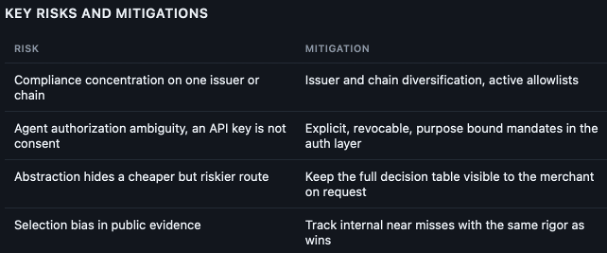
Key Risks and Mitigations:
Every shiny fintech feature eventually meets fraud, regulation, outages, user error, or somebody doing something nobody put in the happy-path diagram. This section asks what breaks and what Stripe would do about it.
Key Performance Indicators to Monitor:
Route level failure and dispute rate, by rail and by corridor. Reconciliation exception rate, trending over time. Time to settlement finality, by route. Blocked or flagged agent transaction rate, treated as a health signal rather than a friction metric to minimize. Merchant initiated route overrides, as a signal of where the default scoring disagrees with real merchant judgment.
These are the numbers that tell us whether the strategy is actually working. Not vanity metrics like “stablecoin transactions increased,” but whether payments settle reliably, exceptions decline, controls catch bad transactions, and merchants trust the routing decisions.
These are the numbers that tell us whether the strategy is actually working. Not vanity metrics like “stablecoin transactions increased,” but whether payments settle reliably, exceptions decline, controls catch bad transactions, and merchants trust the routing decisions.
Conclusion:
A good case study doesn’t end with: innovation happened. It ends with an operating model, a metric, a control, an uncertainty, and a next test. For Stripe and Bridge, the operating model is federated routing under one clean interface, the metric is reconciliation exception rate converging across rails, the control is purpose bound agent authorization, the uncertainty is whether transparency features actually change merchant behavior, and the next test is publishing the route decision table to a real merchant cohort and watching what they do with it.
The big idea is surprisingly uncrypto: make complicated financial infrastructure boring. Stripe wins if developers barely notice the underlying rail while businesses still retain enough visibility and control to trust it.
Source Statement:
The acquisition and product announcements are real Stripe facts. The numbers, routing model, architecture, and recommendation are our analytical sandbox, not leaked Stripe information.
Citations:
Stripe newsroom (Bridge acquisition completion, February 4, 2025), Stripe Sessions 2025, Stripe engineering blog, Stripe newsroom (Ramp stablecoin announcement, July 2026).
Link Loading Soon

